What is underwater therapy? Diving has never been a mere sporting hobby; it is more like a gentle thread that connects me to a group of very special children and to parents searching for hope amidst weariness. Beneath the surface, it has quietly enabled us to construct a deeply healing, social support network.
Text & Photos by Vivi Wong
I was once a primary school teacher whose sporting abilities hovered precariously on the edge of a passing grade. Who could have foreseen that destiny would lead me to plunge head-first into the deep blue world, transforming me into a diving instructor, qualifying me as a DIWA underwater therapist and – ultimately – bringing me to stand in university lecture halls sharing knowledge of the ocean? This remarkable professional metamorphosis has allowed me to appreciate the profound significance behind diving, and it has done far more than just reshape my own life path; it has endowed me with the power to heal others.
The First Challenge
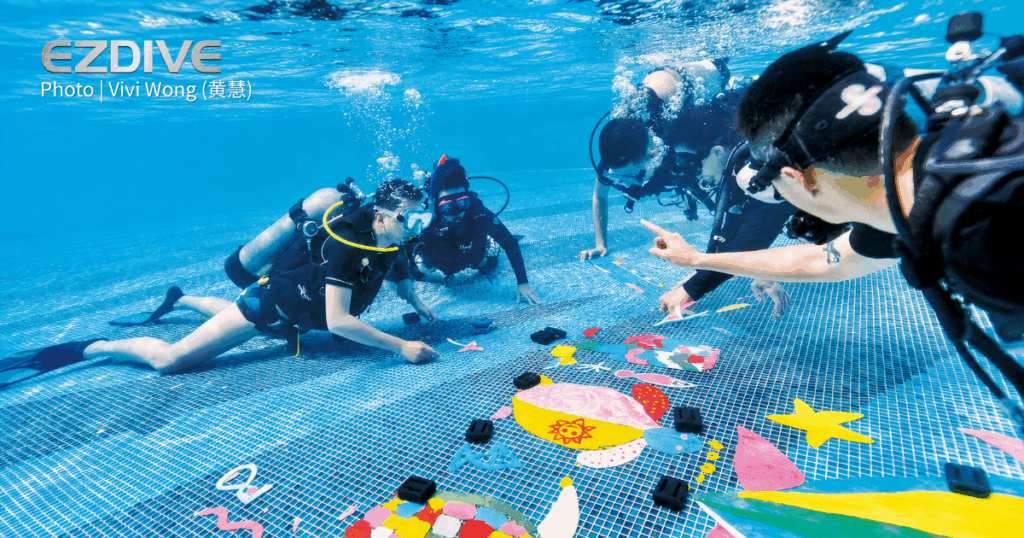
My journey as a diving instructor began at a rather singular starting point – not out of a desire to explore breath-taking marine wonders, but inspired by the ‘Diving for Humanity Programme.’ Through conversations with the project’s founder, Chen Liangbao, I came to understand that the initiative aimed to use the unique medium of diving to soothe the emotions of autistic adolescents and children, gradually coaxing open the doors to their social world. Looking back, the very first girl I taught allowed me to experience both the bitter frustration and the profound enlightenment of this underwater therapy.
This was a girl battling both autism and depression. When we first met, her complexion was sallow, her eyes lacked lustre and she was prone to muttering constantly to herself. Initially, I assumed the greatest hurdle would be the inability to communicate with her. This illusion shattered during lunch one day. I pointed at the menu to ask what she wanted and she suddenly struck me across the face with the back of her hand.
Later, I realised she had been broadcasting signals of acute anxiety all along. On the walk from the training centre to the restaurant, she had been pacing back and forth, repeating like a mantra, I want to dive, I don’t want to eat.I had simply been too insensitive at the time to understand those mumbled emotions.
Yet, the moment she entered the swimming pool, she was utterly transformed. During the 40 minutes underwater, her entire being relaxed. That evening, I unexpectedly received a message from her. It contained just a single, simple sentence, I want to dive again tomorrow. Staring at the words on my screen, all my frustration vanished, replaced entirely by anticipation. It was at that precise moment I truly felt that diving had done far more than just help me as a former athletic under-achiever to fall in love with exercise, it possessed the power to breathe vital energy into these special children. This realisation became my foundational pillar of support.
The Healing Power of Nature
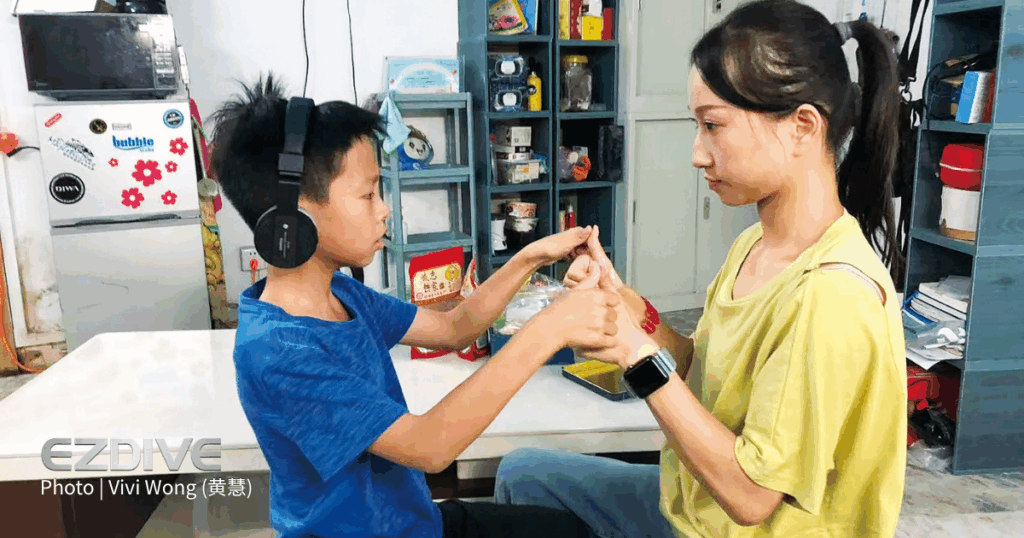
At the course of underwater therapy, I have witnessed the transformations of countless children burdened by autism, but one, Xiao Zhe, remains etched in my mind. He used to play on swings in a frantic frenzy, repeatedly striking his own head whenever anxiety struck and impervious to anyone nearby. Yet, when he submerged into water the first time and encountered the unique tactile sensations of the underwater environment, he abruptly ceased those self-stimulating behaviours. His entire focus became anchored on the act of diving.
We accompanied him as he practised patiently, progressing over the years from the pool to the open ocean. Today, Xiao Zhe executes various underwater skills with grace and confidence. Diving became his sanctuary for emotional release and inner tranquillity. The underwater realm is devoid of deafening noise and convoluted social etiquette, leaving just the gentle embrace of the current and the rhythm of one’s own breath. This raw, natural healing power is something that many conventional clinical interventions simply cannot replicate.
Throughout this journey, I have also come to know many parents of these special children. For them, our two-hour weekly diving sessions represent a rare and precious respite, a window where they no longer have to remain hyper-vigilant about their child, allowing them to temporarily detach from the pressures of daily caregiving. What heartens me even more is that some parents have proactively taken up diving themselves, subsequently taking their children to world-class diving destinations such as Malaysia, the Philippines, Palau and Hainan.
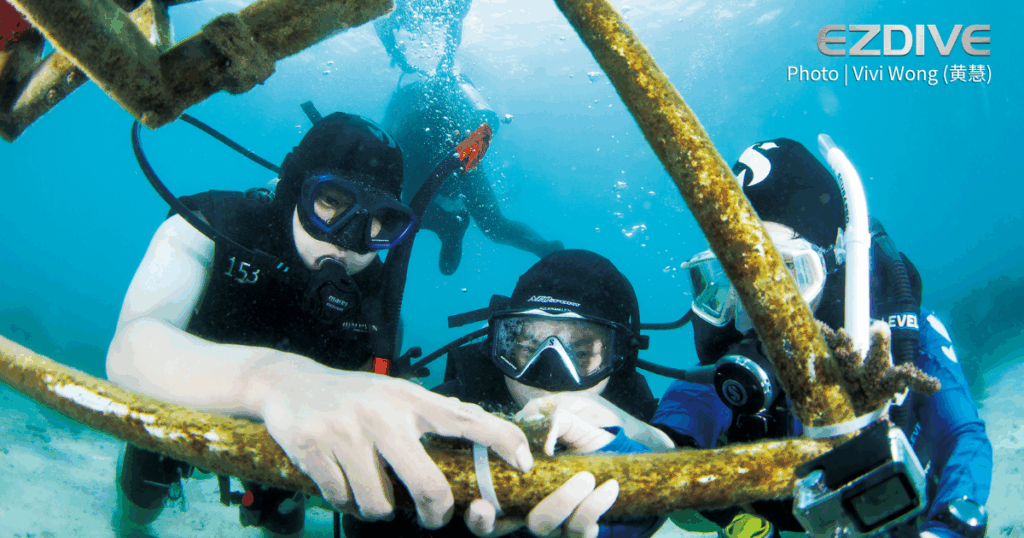
No longer merely parents of special children, these families have transformed into ocean-loving divers. Together, they interact beneath the waves, and upon surfacing, participate in planting coral reefs and clearing marine debris. One mother, on the cusp of retirement, once confessed to me that she had never dared to dream of diving alongside her child, yet it has become their annual covenant. Through diving, her child also befriended numerous university volunteers, gradually learning to roller blade, ride a bicycle and even play the piano and guitar. A life that was once monotonous is blossoming with activity.
Expanding the Horizons of Underwater Therapy
These tangible transformations were later validated by hard data. Since 2024, backed by a research project at the Guangdong Sports Vocational and Technical Institute, our institution and Mind Dive completed a two-year longitudinal study tracking 29 autistic children. By comparing assessment scales across different stages, we discovered that recreational diving significantly enhances their social capabilities. The multi-sensory stimulation underwater, structured interactive scenarios, and coordination training all work together to quietly drive their progress.
The data revealed that after completing ten dive training sessions, over 45% of the children saw their social ability assessment scores more than double, with the most pronounced improvements observed in basic interactive skills. This supports our convictions (phrase deleted, not needed) and draws attention to the potential benefits of diving for individuals regarded as neurodivergent.
DIWA’s underwater therapy courses differ fundamentally from standard certification classes as we do not treat diving as a one-off skill to be acquired, but rather as a long-term intervention strategy. Our training process strictly maintains a 1-on-1 student-to-instructor ratio. During open-water sessions, in addition to the primary instructor, an experienced assistant or a local dive guide is assigned to provide extra safety support; in the early stages of training, we sometimes have 2 instructors guiding a single student. Initial diving depths are also capped between 5 and 8 metres, usually staying at around 5 metres, and all sessions are conducted in familiar waters to ensure maximum safety and controllability.
Prior to a dive, we present ocean-related imagery and soundscapes, guiding the children through meditation and breathing exercises. This builds an emotional, intuitive connection with the sea before we gently guide them to embrace being underwater.
My professional metamorphosis is owed to this expanse of deep blue, which has also inspired students majoring in diving to turn their gaze toward the needs and aspirations of marginalised communities. I have come to understand that the therapeutic power of diving extends far beyond soothing raw emotions and its true brilliance lies in its ability to dissolve barriers. It weaves special children, exhausted parents, practitioners and volunteers into a warm, cohesive community. This social support network, crafted in the depths of the ocean, requires no complex rules – only mutual understanding and steadfast companionship. All I can do is safeguard the original inspiration, ensuring that more souls can discover their own light and warmth within this magnificent deep blue.
For more underwater therapy information, please contact www.divediwa.com.
Eager to dive deeper into compelling ocean stories and expert diving insights? Explore the full edition and join our global diving community.